
Where the Jyotirlinga
Meets the Wild River
Set within the dramatic gorge of the Krishna river in the Nallamala forest, Srisailam’s Mallikarjuna temple is both a Jyotirlinga and a Shakti Peetha — one of India’s rarest and most powerful sacred combinations. Reach it from Tirupati with Sevenhills Tours and Travels.
Our Vehicle Fleet & Pricing
400 km from Tirupati · Available for instant booking · Transparent rates, no hidden charges
| Vehicle Type | Seating Capacity | Price (One Way) |
|---|---|---|
| Sedan | Etios / Dzire (4 + 1) | ₹12,000 |
| Ertiga | 5 + 1 | ₹14,500 |
| Innova | 7 + 1 | ₹16,000 |
| Innova Crysta | 7 + 1 | ₹18,500 |
Ready for the Jyotirlinga Journey?
Srisailam is a full-day trip from Tirupati — let us make every kilometre comfortable. Pre-book your cab today.
The History of Srisailam Temple
One of India’s oldest continuously worshipped temples — Srisailam’s sacred history stretches back over 2,000 years, woven into Puranas, royal inscriptions, and the devotional poetry of Tamil and Telugu saints.
Sri Parvata — The Mountain of Shiva
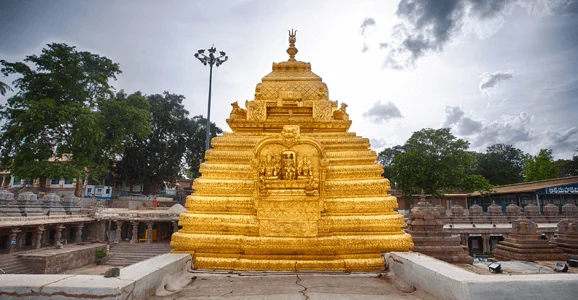
Srisailam is referred to in ancient texts by its Puranic name Sri Parvata — the holy mountain. The Mahabharata, one of the oldest Sanskrit texts, contains explicit references to this site as a place of immense spiritual power where Lord Shiva and Goddess Parvati eternally reside. The Shiva Purana, in its Kotirudra Samhita section, lists Mallikarjuna specifically among the twelve Jyotirlingas — giving Srisailam recognition in India’s oldest religious taxonomy.
The Tamil Shaiva saints — the Nayanmars — visited and composed hymns here as early as the 6th–7th century CE. Thirujnanasambandhar and Thirunavukkarasar both composed Devara hymns in praise of Mallikarjuna, weaving Srisailam permanently into the pan-South Indian Shaiva pilgrimage tradition. These hymns are still recited at the temple to this day, connecting present devotees to a tradition of worship 1,500 years unbroken.
A Thousand Years of Royal Devotion
The recorded history of royal patronage at Srisailam begins with the Satavahana dynasty (2nd century CE), whose inscriptions describe the temple as an important centre of pilgrimage and endowment. The Ikshvaku kings, who ruled the Krishna-Guntur region in the 3rd century, followed with further endowments documented in stone pillars near the temple premises.
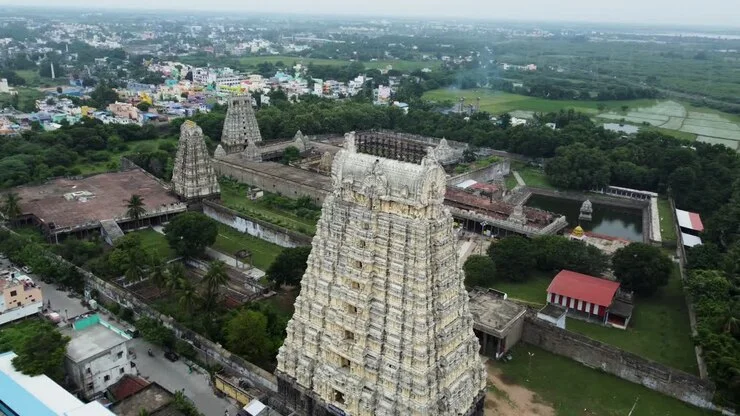
The greatest architectural expansion came under the Kakatiya, Reddy, and Vijayanagara rulers. The magnificent Shikhara (temple tower) over the main sanctum, the towering outer fort walls (the largest of any temple in the Deccan), the Sahasra (thousand-pillared) mandapam, and several elaborately carved entrance gopurams were built during the Vijayanagara period (14th–16th century CE). Vijayanagara emperor Krishnadevaraya, who had also transformed Tirumala, was a major patron of Srisailam — and his contributions are still visible in the precision of the stone carvings on the eastern gopuram.
The Dam, the Tiger Reserve & a Pilgrimage Reborn
The 20th century brought dramatic change to Srisailam — both a challenge and a transformation. The construction of the Srisailam Hydro-Electric Project and dam on the Krishna river (completed in stages through the 1960s–80s) inundated parts of the ancient sacred landscape and required the relocation of some smaller shrines. However, it also created the vast and hauntingly beautiful reservoir lake that now fills the gorge below the temple — a new element that paradoxically enhanced the temple’s visual grandeur.
Today, Srisailam is managed by the Srisaila Devasthanam trust and receives over 1 crore (10 million) pilgrims per year — one of the highest footfalls of any temple in South India. The temple complex has been expanded with modern pilgrim facilities while preserving its ancient stone heritage. The surrounding Nagarjunasagar-Srisailam Tiger Reserve — India’s largest, at over 3,500 sq km — adds a wildlife dimension to the pilgrimage that makes the journey to Srisailam unlike any other. Visit the official Devasthanam website for all visitor information.
Easy Booking Process
Booking a cab from Tirupati to Srisailam with Sevenhills Tours is simple and straightforward. We offer transparent pricing with no hidden charges, verified drivers, and AC vehicles for your comfort and safety. This is a long-distance outstation trip — pre-booking at least 2 days in advance is recommended.
Tirupati to Srisailam
Long-distance outstation trip — pre-book at least 2 days in advance. All AC vehicles with experienced outstation drivers. Overnight and return trips available.
* One way pricing. Toll, parking, driver bata & night halt charges are party expenses. Min 2-day advance booking recommended.
Before You Visit Srisailam
Srisailam requires careful planning — the distance, the forest road, and the multi-shrine visit all deserve proper preparation. Here’s everything you need to know.
Plan an Overnight Stay
At 400 km, Srisailam is best experienced as an overnight trip rather than a rushed same-day return. A night in Srisailam lets you attend the evening Shiva puja (Arathi) at dusk — one of the most atmospheric temple experiences in Andhra Pradesh — and return refreshed the next morning. Book Devasthanam accommodation in advance at the official website.
Pre-Book Your Darshan Tickets
Srisailam offers a tiered darshan system with various pooja and special ticket options. Pre-booking online through the Devasthanam website significantly reduces your waiting time — especially for the Jyotirlinga abhishekam (sacred bathing ritual), which is among the most sought-after poojas and fills up quickly. Our team can guide you through what to book when you call.
The Forest Drive — Wildlife Alert
The Nallamala forest road to Srisailam passes through the Nagarjunasagar-Srisailam Tiger Reserve — India’s largest. Wildlife, including deer, wild boar, peacocks, and occasionally leopards, may be spotted near the road. The forest stretch is open only between specific hours — typically 6 AM to 10 PM. Our driver knows the schedule well and will plan arrival and departure times accordingly.
Don’t Miss the Ropeway Descent
The Srisailam ropeway (gondola) descends from the temple plateau to the Krishna river bank far below. The 5-minute aerial descent offers some of the most spectacular gorge views in all of South India — the river, the dam, the forest hills, and the temple above you all visible at once. This is not to be missed. The ropeway operates on specific timings — ask our driver to confirm when you arrive.
Dress Code for Both Shrines
Traditional dress is required for darshan of both Mallikarjuna and Bhramaramba. Men must wear dhoti/veshti. Women should be in saree or salwar kameez. Mobile phones must be deposited at the counter before entering the main sanctum — a locker facility is available. The temple management is strict but courteous about these rules.
Best Time to Visit Srisailam
The most auspicious and festive periods are Maha Shivaratri (February–March), which sees enormous crowds, and Ugadi / Telugu New Year. October–February is the most pleasant weather for the visit. Avoid the monsoon months (July–September) as the forest ghat road can be difficult and the river is in heavy flood. Call us to plan around your preferred dates.
Seek the Jyotirlinga’s Grace Today
Pre-book your Srisailam cab from Tirupati — overnight trip planning, experienced outstation driver, fully AC vehicle.
Om Namah Shivaya
Book Your Srisailam
Journey Today
Let Sevenhills Tours and Travels take you through the Nallamala forests to the foot of Lord Mallikarjuna — India’s second Jyotirlinga. Experienced outstation driver · Full AC · Overnight trip planning · Instant booking confirmation.